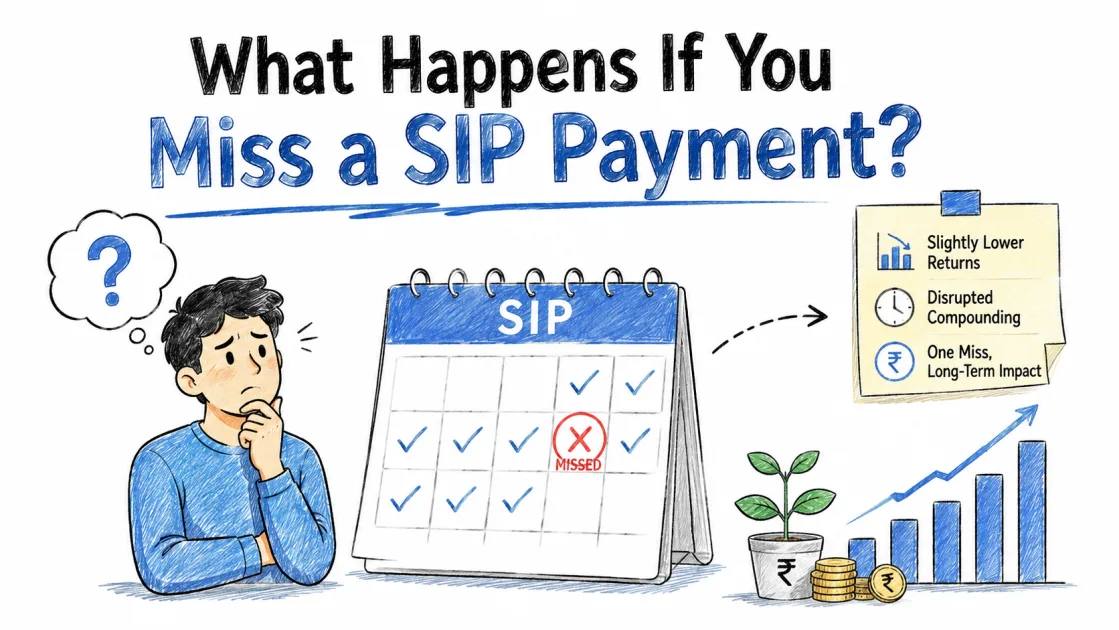
A missed SIP instalment worries new investors far more than it should. It is not a loan default, it does not damage your credit score through the fund house, and no penalty is charged for it. There are real consequences, but they are smaller and more specific than most people assume.
What the fund house does: nothing
A SIP is an instruction, not an obligation. If the money is not in the account on the scheduled date, the debit simply fails and no units are allotted for that month. The fund house does not levy a penalty, does not report the miss anywhere, and does not close your folio.
Your existing investment is entirely unaffected. Units bought in previous months stay exactly as they were, continue to reflect the fund's performance, and remain available for redemption. The only thing you lose is that month's purchase — which matters over a long horizon but is not a crisis in a single month.
What your bank might do: charge you
This is the part that actually costs money. Many banks levy a failed-mandate or insufficient-funds charge when an auto-debit cannot be honoured, and the amount varies by bank. It is not the fund house charging you — it is your bank, under its own schedule of charges.
If a debit has failed, it is worth checking your statement for that charge rather than assuming there was none. Repeated failures mean repeated charges, and the cumulative amount over several months can quietly exceed what the missed instalments would have been.
What happens after repeated misses
One miss is administratively invisible. Repeated misses are not. Most fund houses cancel a SIP automatically after a set number of consecutive failed debits — commonly three, though it varies by scheme.
Cancellation does not touch the units you already hold. What it does mean is that the instruction is gone: nothing will be debited going forward, and restarting requires registering a fresh SIP. The mandate itself usually survives, so restarting is not as involved as the original setup, but it is a step that has to be actively taken — and in practice, plenty of people who intended to restart never got around to it.
What it actually costs you
The real cost of a missed instalment is not a fee. It is a month of investment that did not happen, in a plan whose results depend on the number of instalments made over time.
A single miss in a long-running SIP is close to immaterial. A pattern of misses is a different matter, because it usually signals that the instalment was set too high for the income supporting it. That is the thing worth fixing — not the individual missed month.
If you know a lean month is coming
You have better options than letting the debit fail:
- Pause the SIP. Most schemes allow a pause for a limited period. It keeps the instruction alive, avoids bank charges, and resumes automatically.
- Reduce the amount. A smaller instalment that continues is better than a large one that stops. The habit is worth more than any single month's contribution.
- Change the date. If failures cluster at month-end, moving the date to just after your income arrives usually solves it permanently.
All three are better than the default path, which is a failed debit, a bank charge, and eventually a cancelled SIP.
Does a missed SIP affect your credit score?
No. A SIP is not a borrowing, so nothing about a missed instalment is reported to credit bureaus by the fund house, and it has no bearing on your CIBIL score or on any loan application.
The confusion usually comes from the auto-debit mechanism itself, which is the same plumbing used for loan EMIs. A bounced EMI does affect your credit record, because that is a repayment you were contractually obliged to make. A bounced SIP is simply an instruction that could not be carried out that month, with no obligation behind it.
The one thing worth watching is the bank charge, which is real money regardless of what it does or does not do to your credit file.
The pattern behind most missed instalments
In practice, misses rarely happen because someone forgot. They happen because the instalment was sized against a good month, or dated late in the month, or set up on an account the salary does not actually land in.
All three are setup decisions, and all three are fixable in a few minutes. Size the instalment against your weakest month rather than your average one, date it immediately after your income arrives, and use the account that income arrives in. Investors who get those three right rarely miss a payment at all.
If your SIP keeps failing and you are not sure why, it is usually one of these three. Myfolios is an AMFI-registered mutual fund distributor (ARN-145870) and can look at the setup with you — get in touch, or read our guide to registering a SIP correctly from the start.