Rent or Buy a House? How to Decide for Your Family
Rent isn't wasted money, and a home loan isn't free wealth. The right answer depends on your life, not a rule.
Expert guides on mutual funds, SIP, small-cap funds, and wealth planning — written by AMFI-registered advisors for Indian investors.
Rent isn't wasted money, and a home loan isn't free wealth. The right answer depends on your life, not a rule.
You don't need a bigger salary to start saving. You need a few habits that do the work for you.
A SIP can't outrun a credit card balance. Clear the card first, then invest properly.
The car is the same either way. What changes is how much it really costs you, and how it shapes the next five years.
Big falls are possible. A diversified fund going to zero is a very different thing.
Putting money in a child's name feels right. It isn't always the most practical choice.
A big amount deserves a slow, deliberate plan. The worst thing you can do is rush.
People often assume a distributor's help is free. It isn't, and you deserve to know exactly how it works.
A SIP ending isn't the same as a deposit maturing. Your money stays invested until you decide otherwise.
Your first salary sets habits that can last decades. A few simple choices now make a big difference later.

A neat budget rule from abroad meets a real Indian household. Some of it works. Some of it needs bending.
You don't need a lot of money or a lot of knowledge to start. You need a buffer, one simple fund and a habit.
When two funds are both decent, the difference between them is usually smaller than the difference your own habits will make.
The amount matters less than the habit, and the habit is what turns a small start into something real.
The crash itself lasted weeks. The decisions people made during those weeks shaped their results for years.
Their caution kept many families safe for decades. It just was not built for a long retirement and rising prices.
Not because of distrust. Because life is unpredictable, and a woman with savings in her own name is never left without options.
Not checking your SIP every day is good. Not checking it for ten years has a few hidden risks. Here is the middle path.
The fastest-read sentence in Indian advertising is also one of the most useful. Here is what it is trying to tell you.
Children learn more from what they see at home than from anything they are told. Here are simple ways to make that learning useful.
every RBI rate announcement brings the same question. The answer depends almost entirely on what kind of fund you hold.
The app is a window, not a vault. Your units sit with the registrar in your name. Here is how to check that for yourself.
For twenty years the SIP put money in. After retirement, the job changes: the money now has to come out, steadily, for a long time.
That old certificate in the steel almirah may still be worth something. Here is how to find out and claim it.
The market is one scoreboard. Your fund is playing a slightly different game. Once you see how, the confusion goes away.
A lovely tradition on the stock exchange. For most SIP investors it changes very little, and that is fine.
The honest answer is that it depends on why you are buying. Gold for the family is one thing. Gold as an investment is another.
It happens to almost everyone who invests a lump sum at some point. The decision you make next matters more than the timing you already got wrong.
The videos promise crores from small SIPs. The truth is slower and more ordinary, and for most families it works better than the videos suggest.
The fear is understandable after bank and chit fund collapses. The structure of a mutual fund is very different, and it is worth understanding why.
People ask me this expecting a yes. The true answer is that a SIP is a way of paying, not a product, and the risk sits in what you buy with it.
Most SIPs don't fail because of a bad fund. They fail because they stop in year two or three, just before they would have started to matter.
People want one figure. The figure depends on your expenses, not on an article, and working it out yourself takes about an hour.
Three numbers, three different questions being answered. Once you know which is which, the confusion goes away.
Almost everybody who calls me in a bad year wants to stop everything. There is a better order, and it takes about twenty minutes to work through.
The most sophisticated thinking about risk I have met was not in an office in Indore. It was across a table in a mandi town.
A product is something you buy. A plan is a set of decisions about your own money. Most people have the first and not the second.
A festival is a fine reason to start something you had already decided on. It is a poor reason to decide.
None of them were foolish. Every one of them trusted a person rather than checking a structure.
Nothing about a move stops your investments. It stops everything around them, and you find out months later.
Somebody two months into investing asked me about expense ratios. Good question, wrong year.
Six things, and only two of them are about investing. The rest is about not undoing yourself.
Raise the instalment before the new salary reaches your account and you never feel it. Wait two months and you will.
Every one of these has produced a different answer than the person walked in expecting. That is why I keep asking them.
Somebody asked me last month what I actually do for the money. Fair question, so here is the honest inventory.
The tradition is not the problem. Waiting is. Most people who postpone to a date do not start on that date either.
The regrets are always about timing, size or paperwork. Never once about which scheme.
A handful of clients contact me roughly once a year. Their portfolios are, quietly, the best ones on my desk.
The question has a hidden second half nobody says out loud: how to double it quickly and safely. That combination does not exist.
Most of what I say is some version of "keep going". Here are the exceptions, and why each one is not about the market.
People ask which fund. Almost nobody asks what happens if they need the money early, or if I am not around.
The call usually comes after something matures. That timing is not a coincidence and it is worth understanding.
People expect me to start with the funds. The funds are the fifth thing I look at, and usually the least interesting.
The difficulty is not that the advice is bad. It is that refusing it costs something at a family gathering.
The gap between stopping and restarting is usually years, and almost never because the money was not there.
A monthly number about a fifteen-year holding contains almost no information and quite a lot of feeling.
Saying "that is not my area" costs a distributor something every time. Here is why I say it anyway, and the list of things it applies to.
You sent the PAN copy last year. You are being asked again. It is annoying, some of it is unnecessary, and here is the honest explanation.
It is not about trust and it is not about competence. It is about one person being the only route to information that belongs to both.
Most people who stop, stop in year one or year two. Almost always because nothing appeared to be happening.
Every year the same call, a few weeks before the festivals. Here is the order we actually suggest, and why the investing part comes fourth.
The account opens in minutes now instead of weeks. The thing that decides how it turns out is exactly what it was in 2014.
People arrive wanting a fund name. Here is why they never find one here, and what we offer instead.
You can help with almost everything. The identity, the account and the face on the video have to be theirs.
Two people can hold the identical scheme and see different numbers. Almost none of that is the scheme.
One of these has a certain outcome and the other does not. That settles more of it than people expect.
Four parties, and the one you deal with is the only one that never holds your money.
Usually nothing happens to your units. Occasionally you get a free exit window, and that is the letter worth reading.
Two minutes, a public register, and no awkwardness. Do it for us as well as for anybody else.
It is not a redemption, it does not need the old distributor to agree, and nothing is sold.
No, you do not. Most mutual fund investors in India have never had one, and that is perfectly normal.
An index spends a lot of its life near a high. That is what a rising series looks like from inside it.
Your SIP is six years old. Last month's instalment is one month old. The scheme counts the second one.
Nothing breaks on the day you resign. It breaks about two months later, quietly, and most people never restart.
One step, done once, and nothing works until it is. Here is how to check yours and what to do if it is stuck.
Nobody sits down and decides to own eight schemes. It happens one reasonable decision at a time.
A red number early on tells you almost nothing. Here is how to tell the difference between noise and a real problem.
Most people read one number and ignore the rest. The useful information is in the lines nobody looks at.
A lower NAV is not a discount. It is arithmetic, and mistaking it for value costs people real money.
Nothing breaks until you need the money. Then everything breaks at once.
You have less time and more money. That combination changes the plan more than the age does.
One statement, your PAN, and about ten minutes. Most people find at least one folio they had completely forgotten.
The question is not which fund. It is what number you can still be paying in month fourteen.
What the fund house needs, why a nominee changes everything, and the three things that stall most claims.
Stopping the instalment and taking the money out are two separate switches. Most people only need one of them.
A few minutes per folio now saves your family months of paperwork later. Here is how nomination works, and what to check on older folios.
KYC, mandate, fund, date — the four steps to register a SIP online, what each one needs, and the mistakes that cause delays.
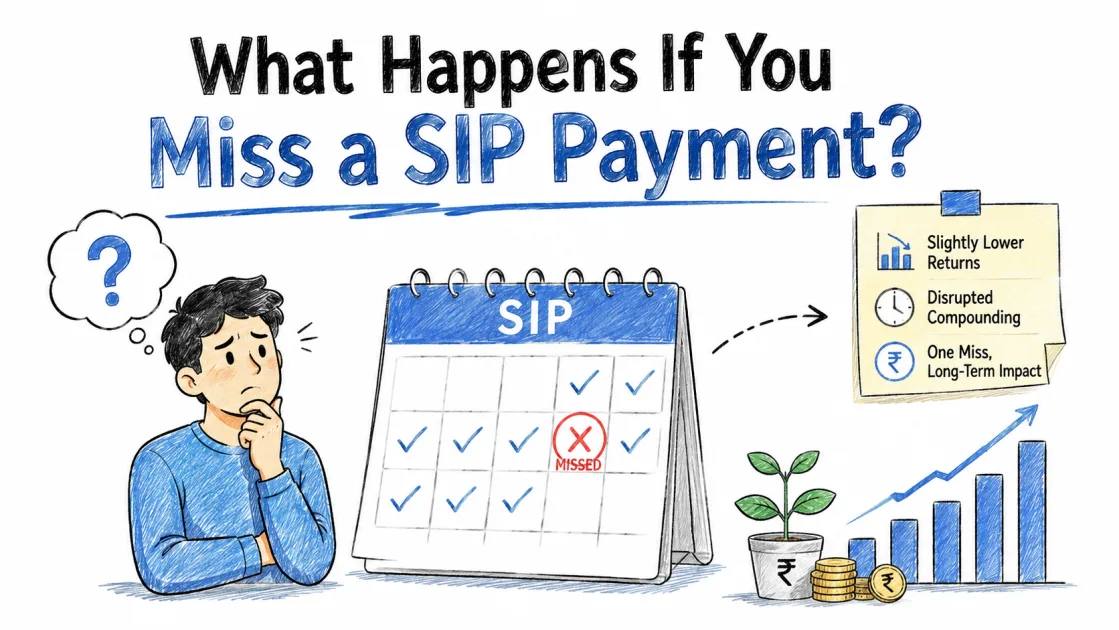
No penalty from the fund house, possible charges from your bank, and cancellation after repeated failures — what a missed instalment really means.
Open a FREE Demat account online in 5 minutes with Aadhaar OTP. Zero opening fee, paperless process, start investing today.
New to investing? Best Demat account for beginners - zero fees, simple app, free account opening, backed by India largest broker.
Open Demat account in 5 minutes with zero balance requirement. No deposit, no upfront fees - just PAN + Aadhaar and you are ready.
Honest Zerodha Demat account review - India largest broker. Pros, cons, charges, Kite app, Coin for mutual funds. Everything covered.
Intraday trader? You need lowest brokerage + fast execution + reliable app. Best Demat account for intraday in 2026.
Student over 18? Open a free Demat account with just PAN + Aadhaar. No income proof. Start investing pocket money from day one.
Stop paying fat brokerage. Lowest brokerage Demat accounts compared - 0% delivery, Rs.20 flat intraday. Open today.
F&O trader? Best Demat account with low brokerage, margin, and stable app. Warning: 90% F&O traders lose money - read first.
Tired of paying Rs.300-700 yearly AMC? Demat accounts with ZERO AMC - free forever. Compared for 2026.
No salary slip? No ITR? No problem. Open Demat account with just PAN + Aadhaar. Here is what you can and cannot do.
Joint Demat account - open with spouse, parent, or sibling. Complete guide to joint holder rules, tax and opening process.
Minor Demat account lets you invest for your child below 18. Guardian operates, child becomes owner at 18. Full guide.
NRI? Open Demat account in India from abroad. Complete guide to PIS, NRE/NRO, tax, and investment limits.
Pay ZERO brokerage on equity delivery - forever. Top zero-brokerage Demat accounts in India 2026 compared.
Trade stocks from your phone. Best Demat apps for mobile trading in India 2026 - Kite, Upstox, Groww compared.
Want to apply for IPOs? Demat account is mandatory. Complete 2026 guide to IPO application via UPI/ASBA with your Demat.
Retired? Demat account is still for you. Open easily, invest safely, generate income. Complete 2026 guide for senior citizens.
Confused whether Demat is needed for mutual funds? Short answer: NO for MFs, YES for stocks. Full guide with pros/cons.
Housewife chahti hai apna investment portfolio? Open free Demat account without any income proof. Complete 2026 guide.
Retail (individual) investors guide to picking the best Demat account in 2026. Charges, features, and step-by-step opening.
New 2024 tax rules changed mutual fund taxation completely. Complete 2026 guide - LTCG, STCG, ELSS, debt funds.
Large-cap, Mid-cap, or Small-cap - which mutual fund category is right for you? Detailed comparison on returns, risk, allocation.
Planning a 5-year SIP? Top 10 mutual funds for 2026 across categories - picked on rolling returns and risk metrics.
Demat account looks free but has many hidden charges - AMC, DP charges, STT, GST. Complete 2026 breakdown.
KYC is mandatory before first mutual fund investment. Complete 2026 guide with Aadhaar e-KYC and how to check status.
NAV is mutual fund per-unit price - but lower NAV does NOT mean cheaper or better fund. Beginner guide with misconceptions busted.
Direct plans give 0.5-1% higher returns than Regular plans - over 20 years that is Rs.10-20 Lakh extra. Here is why most investors choose wrong.
Confused between Demat and Trading account? They are different but both needed. Simple difference with real examples.
Open a Demat account in under 15 minutes online. Complete 2026 guide with documents, steps, charges, and best broker picks.
Expense ratio is the silent killer of mutual fund returns - even 0.5% extra can cost you lakhs over 20 years. Here is everything you need to know.
Skip the confusion. This 7-point checklist tells you exactly what to look at (and what to ignore) before buying any mutual fund.
The honest answer to "SIP ya Lumpsum?" — with backtested numbers, the psychology angle, and a simple rule for choosing.
A data-backed guide to the top-performing mutual funds of 2026 — small-cap, mid-cap, flexi-cap and more. Know which funds suit your risk appetite.